Sunday, January 11, 2026

A Leopard, a road and a memorable walk in Ramghar Uttarakhand

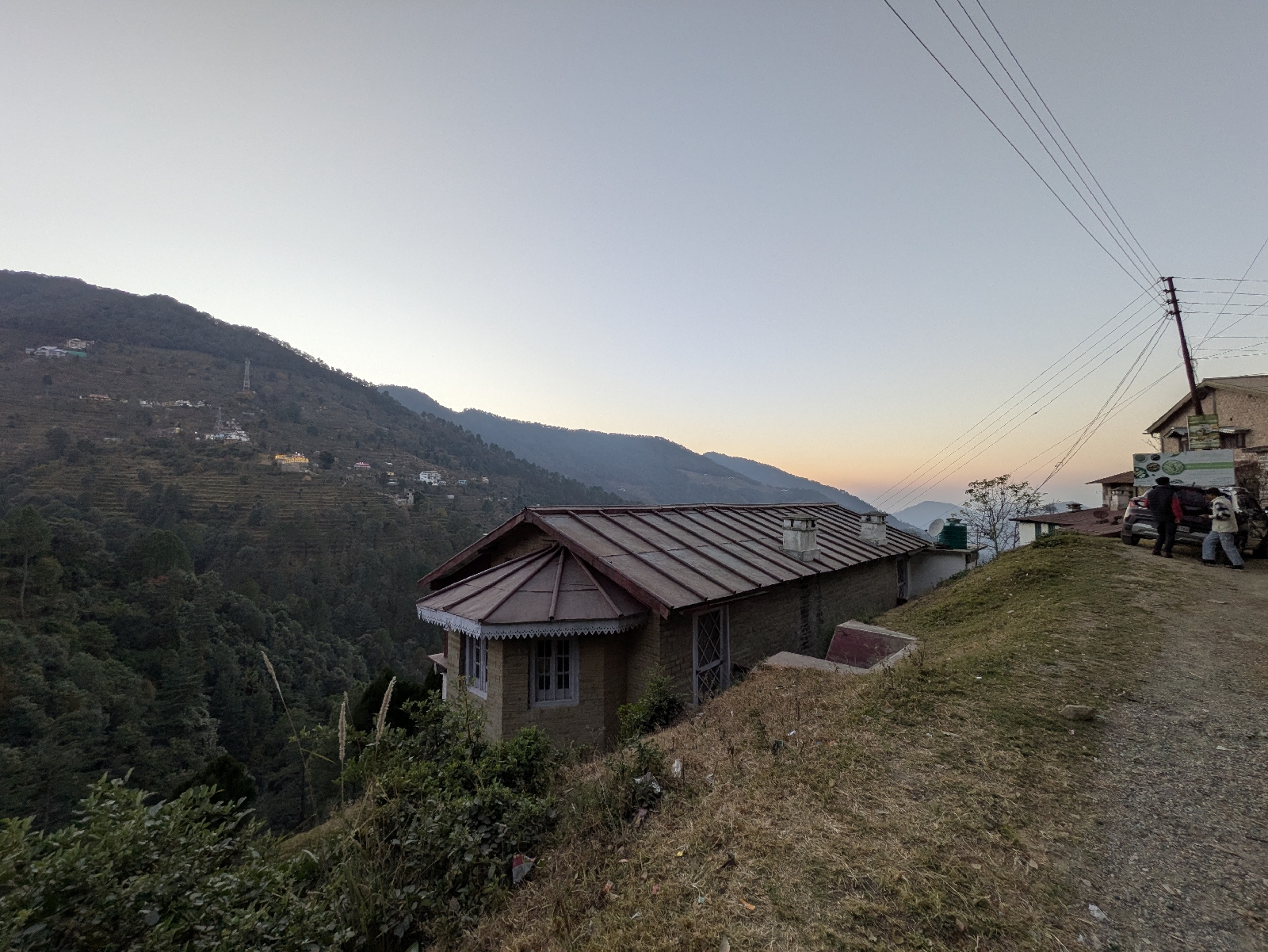
I've often been asked why, from walking 10,000 steps a day, I can increase it to 20,000 in Himalayas where the terrain Is rough. While I hate using the walking machine or thingjamay  in the gyms. The answer is simple: the view, my dear, the view. This is the road to Dak Bungalow, and the best part was when I saw a leopard cross the creek below me. He seemed more shocked than I was. We exchanged glances. He was rather young and inexperienced, seemingly out of place and apologetic, with a grin that said, "Oh hi, we weren't supposed to meet. Please don't report this to the forest department."
I was simply admiring the bees and flowers. I chose not to mention that I knew the Chief Conservator of Forests for Uttarakhand. Name-dropping rarely ends well, especially when a leopard, tired of forest trails, wanted a stroll on the nice tarmac road humans had built in his territory. Plus, he was quite friendly with me; with my physique, I could have fed him for a week or two. So, we decided to avoid involving the Uttarakhand Forest Department. Besides, who knows how that would end? Government officials are notorious for their excessive paperwork. My father, a government employee, had a file on me filled with health records, birth certificates, academic records, clothing purchases, school fee receipts, and even telephone and electricity bills. To keep it short, both his and my experiences with bureaucracy led us to conclude that discretion and non-disclosure were the best options. With a brief exchange of glances, we continued our respective journeys.
I refrained from offering him any advice. Young people today tend to react violently to unsolicited advice on civility and gentlemanly behavior. I suppose it was my father's tennis racket and powerful forehand and backhand that kept me from becoming the kind of thug the current generation seems to want to emulate. So, we ambled along, with me gaining wisdom about the attitudes of young people, while the leopard might have been contemplating his near-miss. Had he used the word "uncle," I might have been compelled to give report him to the forest ranger. But like a good, old-fashioned gentleman, he simply ambled away and jumped down a steep incline without injury. I made a mental note to mention this to his parents if I ever met them. After all you never know who you will meet in the Himalayas from Saint to sinner, all have made their abode here plus Indian parents have a knack for humbling their children, and they would undoubtedly pull him down a peg or two . "Call me uncle, will ya?" I mused.
As the sun began to set, I took out my torch and continued my walk, encountering a cow or two. Along with a few idiots who seemed to have learnt how to drive their motercycle  via video games and were trying to set land speed records on Village roads. I beleive you call them politely as Morons of the first order of BharatThen, I received a call from my nephew warning me not to walk on the road below due to roaming leopards. I decided not to tell him about my pleasant encounter with the young leopard, as unmarried nephews with younger sisters have a tendency to preach. It made me wish he were married, as then he would understand the power of  woman's words, which even a passionate missionary can't match even though his faith Christ might be as much as St.Peters which is not saying much since they did denying knowing Christ but then you get the general idea.
Oh, what a tangled web we weave when we get married... But that's a story for another time. Dedicated to R.C. Dikshit, IPS who always had a new story to share.

When People leave for the bright light and you search for your home...

There is a specific kind of solitude that settles in as we grow older and the people we love begin to leave us. It is not merely the loss of affection; it is the loss of your history. These people were the emotional anchors of your childhood—essential as a lucky charm, comforting as a beloved toy held tight against the dark. But everything has its time, and eventually, people depart.
I have often believed that a soul holds onto life only as long as it wishes, until the moment comes to let go and embrace the Divine. They find peace, yet we, whose orbits revolved around them, are left navigating a sudden emptiness. Life moves forward, but we remain a little more lonely.
On January 10, 2026, I lost my maternal aunt (Mami), Dr. Puspa Sarin. She was my mother’s dear friend, the very woman present in the delivery room when I took my first breath. There is a cruel irony in losing her just as I left Noida for Pune. In retrospect, I realize that her presence was the tether that kept me in Noida for so many years; she was family, she was home.
It is a strange paradox: when you are a child, 'home' is a certainty, but when you are fully grown, it becomes a question. As she passes on to be with the Almighty, I am left wondering—where is my home now? Is it Nainital, where I spent my childhood? Is it Lucknow, where our house stands? Or is it Agra, where my parents passed away? It is terrifying that something as fundamental as the concept of home can be shaken by a single death.
But then, life is rarely known for its kindness. As the years pass, I realize I now know more people I love in the realm above than I do here on this physical plane. As Harivansh Rai Bachchan wrote so poignantly:
दृग देख जहाँ तक पाते हैं, तम का सागर लहराता है,
फिर भी उस पार खड़ा को‌ई हम सब को खींच बुलाता है!
मैं आज चला तुम आ‌ओगी, कल, परसों, सब संगीसाथी,
दुनिया रोतीधोती रहती, जिसको जाना है, जाता है।
मेरा तो होता मन डगडग मग, तट पर ही के हलकोरों से!
जब मैं एकाकी पहुँचूँगा, मँझधार न जाने क्या होगा!
इस पार, प्रिये मधु है तुम हो, उस पार न जाने क्या होगा!
May she be happy, wherever she is.

Wednesday, October 1, 2025

Eternal Musafir

I walk the roads that never end,
From dawn’s first blush to twilight’s bend,
A seeker bound by neither place,
Nor tethered to one fleeting face.
The stars above, my timeless guide,
The oceans vast, my restless tide,
The mountains whisper, winds reply,
To footsteps tracing earth and sky.
I drink from springs of joy and pain,
Through desert heat and monsoon rain,
Each mile a verse, each halt a rhyme,
Etched on the scroll of endless time.
No home, and yet the world is mine,
In every heart, a sacred shrine,
For journeys weave what maps conceal—
The roads that teach, the wounds that heal.
And though horizons fade to shade,
My spirit walks, unbound, unswayed;
For what I am, I shall not cease—
An eternal musafir, in search of peace.

Thursday, September 18, 2025

An Elder brother Extraordinary Adarsh (not that much) Nath Segal

Ladies and gentlemen, pray compose yourselves, tighten your cravats, and adjust your monocles—for what I am about to present to you is no ordinary mortal, but a veritable one‑man circus, mechanical oracle, and impresario of chaos. Permit me to introduce: my elder brother—an altogether extraordinary specimen of humanity.

This was the fellow who transformed bedtime into theatre, narrating Treasure Island with such gusto—and sound effects worthy of All India Radio—that pirates and parrots seemed to take up residence in our room. He was also the chap who taught me to walk, tie my shoelaces, and wrestle with the great British invention known as the tie—as treacherous a garment as ever strangled a schoolboy.

Scooter rides? Ah, but here lies a saga! The machine in question was, more often than not, pinched from our unsuspecting maternal uncle and taken to a most unusual proving ground. This was no gentle road but one used by the Army to teach drivers the noble art of vehicular survival: hills, broken bridges, bone‑rattling obstacles designed to challenge both man and machine. And there we were, two boys defying the laws of Newton as our humble LML scooter would launch itself skyward, wheels somersaulting, and invariably land with me acting as a rather reluctant cushion atop my elder brother’s heroic frame.

I can say with hand on heart and a straight face that LML scooters were jolly tough contraptions indeed. After all, James Bond may have flown over broken bridges in an Aston Martin, but my brother managed the same feat on an LML—a spectacle that, when viewed from the saddle, was exhilarating, terrifying, and oddly refreshing for the soul.

His duties, I might add, extended well beyond gravity‑defiance and school runs. He also chauffeured me on solemn expeditions to our family vet, the resplendent Colonel Y. N. Upadhyay—whose moustache alone could have commanded a cavalry regiment.

He browbeat me into buying books I had no earthly desire to read, and yet, curiously, I treasure them still. He gamely took up horse‑riding with me, dropped me to school with the air of a reluctant chauffeur, and was my companion at my very first film—where, I regret to inform you, I howled like a banshee when the hero met his untimely end.

At home, he reigned supreme as the family mechanic and local oracle for all matters nuts, bolts, and grease. Motorcycles trembled before him as he stripped and reassembled them, with me in the capacity of humble tool‑bearer. Generators, cars, cassette players, tape recorders, cordless phones—all submitted to his spanners. When the town bought their dish antennas, he simply manufactured one. If there was a solar eclipse, he’d whip up a telescope. On quieter days, a microscope would emerge from his tinkering hands. Frankly, if necessity is the mother of invention, my brother was the star pupil.

The result? A childhood both chaotic and enchanting, its soundtrack the clink of spanners, the crackle of tape recorders, the hum of generators, the Colonel’s cavalry moustache, and the occasional dramatic sob in a darkened cinema.

So, ladies and gentlemen, steady your nerves and still your beating hearts—for here he is, my elder brother: a man who could make a scooter fly, a telescope materialise, and a childhood sparkle. A chap quite out of the ordinary run of men—who gave me tales instead of toys, adventures instead of lessons, and memories far sturdier than any machine he ever repaired.

Tuesday, September 2, 2025

US - India Trade deficits. The real Picture as on 2nd Sept 2024

Projecting the US as the greatest victim of India in trade is complete baloney. The fact is:

The US deficit with China is $270 billion, with the EU $161 billion, with Mexico $157 billion, with Vietnam $113.1 billion, with Taiwan $67.4 billion, with Japan $62.6 billion, with South Korea $60.2 billion, with Canada $54.8 billion, with Thailand $41.5 billion, and with India $41.5 billion.

Now, let's look at US-India trade.

India-US trade in services was about $83.4 billion, with US services exports to India at $41.8 billion and US imports from India at $41.6 billion.

Total disaster? Let's look at that too.

India-US defense trade was virtually nil in 2000. It has touched a total of almost $22 billion in 2024.

Why this whining then by the USA?

The claim that we have offered to reduce our tariffs to nothing is true for some products, but our red lines are firm. Unfortunately, US officials are being economical with the truth!

By the way, as of now I am not talking about USA-Russia trade, which is around $4.57 billion. While India trades with Russia in Indian Rupees, the USA trades in dollars. Russia's exports to Europe were $85 billion in 2023, and Russia is the 3rd largest trading partner for Europe, but the bad guy is supposed to be India?

US debt:

$250 billion in U.S. Treasury securities is held by India, making it the 12th largest foreign holder of the US government securities. This is as of 2024, and the figure would have gone up in 2025.

Job creation in the USA:

Indian companies have created about 425,000 direct jobs in the United States as of 2023, according to a survey by the Confederation of Indian Industry (CII). These jobs span all 50 states, with the highest concentrations in Texas (20,906 jobs), New York (19,162 jobs), New Jersey (17,713 jobs), Washington (14,525 jobs), Florida, and California. Indian firms have invested more than $40 billion in the US across various sectors including IT services, pharmaceuticals, manufacturing, and healthcare.

Frankly, under the current administration, I think it is best to keep away from the USA because we can be sure we will not be treated fairly. Let's think about good terms after Trump's term is over. In the meantime, work on cutting access to US companies and build the equivalent of Facebook, X, Google here. The best way is to ban them and only allow Indian equivalents like China has done. Move away from the US dollar as the reserve currency. Remove the Ford Foundation and US-backed NGOs, which will be used by the USA for regime change operations like they have done in Bangladesh and Pakistan. Remember, only 3 years, 9 months, 2 weeks, and 1 day of the Trump regime are left. Use that time to tie up with Russia, go for joint development of aircraft and other military hardware. After all, Russia has always helped India since 1947, and when the USA sent the 7th fleet against us in 1971, it was Russia that stopped them. Otherwise, the Americans wanted to attack India. Nothing to worry about. Stop dependence on the USA; in any case, the USA never helps its allies. So, it is better not to be too friendly with them. A nation has interests, not friends.

Monday, September 1, 2025

Does Truth Win? a poem in Hindi on truth

सच बोलना गुनाह हो गया,
दोस्त ने दर्द बढ़ा दिया,
जो चुप थे खामोशी में,
वो आवाज बन के चमका दिया।

ज़ख्म छुपाने के बहाने,
हर लफ़्ज़ ने दिल को छिड़का,
साफ़ बोलना अब गुनाह समझा,
सच की सदा गुनाह बन गया।

दिल के ज़ख्म के साये तले,
मुक्ति की तलाश में हम,
सच के रास्ते पे चलना,
है मुश्किल, भी पर ज़रूरी हम।

ये दुनिया है नफ़रत के संग,
जहाँ सच भी कभी दर्द देता है,
फिर भी दिल से पूछो तो,
सच ही वो राह है जो जीता है।"

Friday, August 29, 2025

Desi school vs Convent

When schools of missionary stamp, with fervour undimmed and zeal so bright, Convert curiosity's lamp into dogmatic light; They teach in syllables foreign, rituals far from home, And seek, alas, to re-script the Indian genome.

But lo! In Himalayan heights where Sher-ka-Danda broods,

A bania-taught sanctuary guards our hallowed moods. Mandatory subjects, yes-CBSE's parsing drills- But Sanskrit prayers waft morning through Nainital's chills.

Here, culture's tapestry is embroidered in every stride, Diwali lamps, Holi's splash, where heritage is pride. They do not merely school-they awaken and inspire, Birla Vidya Mandir, world's summit, hearts afire.

To those who tout conversion as academic art, Let them behold where tradition's pulse outsmarts. For knowledge unmoored from roots is a ship lost at sea,

Our alma mater, the greatest, binds soul and esprit

The world may praise many halls, and alumni shining gold,

But the greatest school teaches mind-and keeps the culture bold

Tuesday, July 15, 2025

George the Giant

For a long time, I have pondered why a leader like George Fernandes aligned with Indira Gandhi against Morarji Desai in the late 1970s. As an admirer of Fernandes, this decision seemed inconsistent with his character. The answer, revealed in Neerja Chowdhury’s book How Prime Ministers Decide on page 121, lies in his deep loyalty to his friend Madhu Limaye. When Limaye appealed to their years of friendship, asking, “Do all our years of friendship mean nothing to you?” Fernandes made a choice driven by personal loyalty. This act echoes the Mahabharata, where Karna joined the Kauravas out of loyalty to Duryodhana, illustrating how friendship can lead to profound sacrifices, even across centuries.
Like Karna, whom I also admire, Fernandes sacrificed much for his friend and never spoke of this decision publicly, revealing the depth of his character. A man of remarkable integrity, Fernandes, a South Indian born in Kerala, was forged in the North. Like Prime Minister Narendra Modi, he once disguised himself as a Sardar. His flawless Hindi, unwavering support for Tibet—far ahead of his time—and his accessibility as a minister set him apart. He famously removed the gate of his residence, ensuring it remained open to all. A Christian who could recite the Gita,  starting off as a priest and then leaving it because he did not agree there is no slot in which one can put in George Fernandes was a unique figure in Indian politics. He was truely a nationalist from Kerla he  went to west India and from there to Bihar. Show me some one who can win in South west and north of India. For a long time I thought he was a bihari because he spoke flawless bihari 

There is much I dont agree with but then I am a man who rarely agrees 100% on anything. 
My respect for him deepens with every detail I learn. He was a leader of extraordinary courage and conviction, cut from a different cloth. I hope George Fernandes is at peace, wherever he may be.
I am reading a few books about him and this article will be updated with whatever I get to learn over a period of time. 

Wednesday, November 20, 2024

when your past catches up with your present and memories bring a smile to your face

Many eons ago (or "A long time ago") on a cold and rainy afternoon, a boy read a story about a shepherd who would guide crippled planes back over the dark and foggy North Sea. The rain was pattering on the tin roof. A glass of hot tea, quickly turning lukewarm, was in his hand as he read and reread the story. He mused that his elder brother, Adarsh Nath Segal, had told him the story.
Then, he walked out of the school library into the warm sunlight and walked up to his house. He saw Nainital and the plains stretched out like a postcard just behind the Government House. As he looked out, he fell into thought and enjoyed the warm sun.
Years later, on a lazy Saturday afternoon, the same boy turned on the TV, put on Disney Hotstar, and found the same story as a movie there:
https://www.hotstar.com/in/movies/the-shepherd/1260154875
In a perhaps coincidental turn of events, he was going to a meet at 7:00 PM with some 20 of his old school students. Is the world round, or is this a coincidence? Is there even such a thing as coincidence? If only we knew... the  paheli puzzle called life. Perhaps Longfellow (Henry Wadsworth Longfellow) said it best 

I shot an arrow into the air,
It fell to earth, I knew not where;
For, so swiftly it flew, the sight
Could not follow it in its flight.

I breathed a song into the air,
It fell to earth, I knew not where;
For who has sight so keen and strong,
That it can follow the flight of song?

Long, long afterward, in an oak
I found the arrow, still unbroke;
And the song, from beginning to end,
I found again in the heart of a friend

But the story does not end there riffling through the pages of an old edition of Reader Digest, guess what I found ?  The same story. The story is called The Shepherd is a 1975 novella by British writer Frederick Forsyth(I am a great fan of his works ) The Shepherd relates the story of a De Havilland Vampire pilot flying home from RAF Celle in northern Germany to RAF Lakenheath in Suffolk on Christmas Eve 1957, when his aircraft suffers a complete electrical failure mid-flight.

However, if my memory serves me right, the story as told to me by my elder brother was much better, the way he would add sound effects, the man deserved to be on the radio. Unfortunately, the world never got to hear him. I can still hear the way he told me the difference between a jet engine and a twin-engine propeller aircraft made of wood. My elder brother was Google even before Google was aware that it is Google. Suffice it to say, the sound brought my mother into the room to see what we were doing, but that is another story. The art of storytelling in an era when elder brothers taught you how to ride a cycle, walk, and bullied you into buying books they wanted. (Reader, don't worry, I have spent the last 30 years gifting him things that want and then keeping them. All my mobile phones are a gift to him:-)), apart from taking you on scooter rides where they banged up the scooter and both of uS were supposed to hide it (a blog on this later). Ahh, what a time it was, what a time...

Wednesday, November 13, 2024

Woman Empowerment in India is actually going back to the cultural Bharat had before invasions and rule by both Islamic and Christian invaders

Indian National Army, fighting against the Allied forces in World War II, had an all-woman regiment, the Rani of Jhansi Regiment, established in July 1943. Unfortunately, due to the short-sightedness of the military at the time of Independence, it did not last. India had to wait until 1992 when women were granted Short Service Commissions under the Vajpayee government during the Kargil War. Women pilots flew in combat zones from 2015, and more branches were opened up. Then, in 2021, under the Modi government, the NDA was opened up for women. Today, we have reached a full circle with an all-women battalion that will even engage in anti-terrorist operations. In the next five years, we might once again see a women's regiment.
Ironically, the first woman warriors in India date back 4,000 years to the Sinauli archaeological site. Years of repression under Islamic rule, followed by Western stereotyping of women's roles under British rule, led to the suppression of women's rights in India. However, mighty as the Islamic or British Empires were, India still managed to produce a Razia Sultan, Noor Jahan, and Chand Bibi, who led and ruled even during Islamic rule in India, where traditionally the role of women is not very strong. I am not counting the Hindu queens who ruled and fought Islamic rulers here, as there were many, and Islam was not able to subjugate all of India completely.
When the British arrived, they found they had to fight women rulers like Rani Chennamma, Ahilyabai Holkar, Rani Lakshmi Bai, Begum Hazrat Mahal, Rani Velu Nachiyar, etc. Eventually, the Victorian British norms curtailed women's rights and repressed them. The British influence destroyed many matriarchal societies in India, like the Nairs. Women's education suffered but was protected in places under Indian rule, like the Baroda Gaekwad State, which made education universal in 1906, while the first girls' school was set up in 1875. These notable exceptions existed.
The British, due to the 1857 First War of Indian Independence, saw women fighting and leading armies against them. Like typical Europeans, they shamed and called out the character of such women, especially in the North, calling them all nautch girls (dancing girls), even going so far as to say that prostitutes were instigating their troops against them! The repression that followed destroyed women's rights in India, which even the Islamic occupation was not able to do. The British took women away from leadership positions, even then it was the Indian Ranis who were among the first women drivers in the world. In 1905, we had a woman driver, and the Maharani of Bhavnagar, Nandkuvarba, in 1910, took the British Governor of Bombay for a spin in her car, which made front-page news for the British!
It has taken us over 77 years, but women are once again rising in India. Of course, the Western world likes to tell you otherwise. They, who destroyed women's rights in India, claim to have brought civilization to a nation that existed even before the Greeks did. We had covered drains before King Solomon's time and open drains under the British Raj! Remember your heritage and remember that you come from a nation that has considered women as Shakti. What you are seeing in the CRPF Battalions is a return to our roots. After 77 years, we are finally removing the dust of centuries of slavery and rising once again. Diversity and women's empowerment existed 4,000 years ago in India; we are today trying to reach the same levels we had before the invasion of this nation! This CRPF Battalion is just the first step to regain what we lost!